
The Seven Gallup Leadership Competencies –And Where Leaders Are the Weakest
A recent Gallup analysis of decades of data on top transformational leadership performers identified seven competencies that correlate with organizational success. Importantly, these aptitudes drive performance when they are openly modeled and visible. They are:
1. Build relationships. Establish connections with others to build trust, share ideas and accomplish work.
2. Develop people. Help others become more effective through strengths development, clear expectations, encouragement and coaching.
3. Lead change. Recognize that change is essential, set goals for change and lead purposeful efforts to adapt work that aligns with the stated vision.
4. Inspire others. Encourage others through positivity, vision, confidence, challenge and recognition.
5. Think critically. Seek information, critically evaluate the information, apply the knowledge gained and solve problems.
6. Communicate clearly. Listen, share information concisely and with purpose, and be open to hearing opinions.
7. Create accountability. Identify the consequences of actions and hold yourself and others responsible for performance.
Where are leaders the weakest?
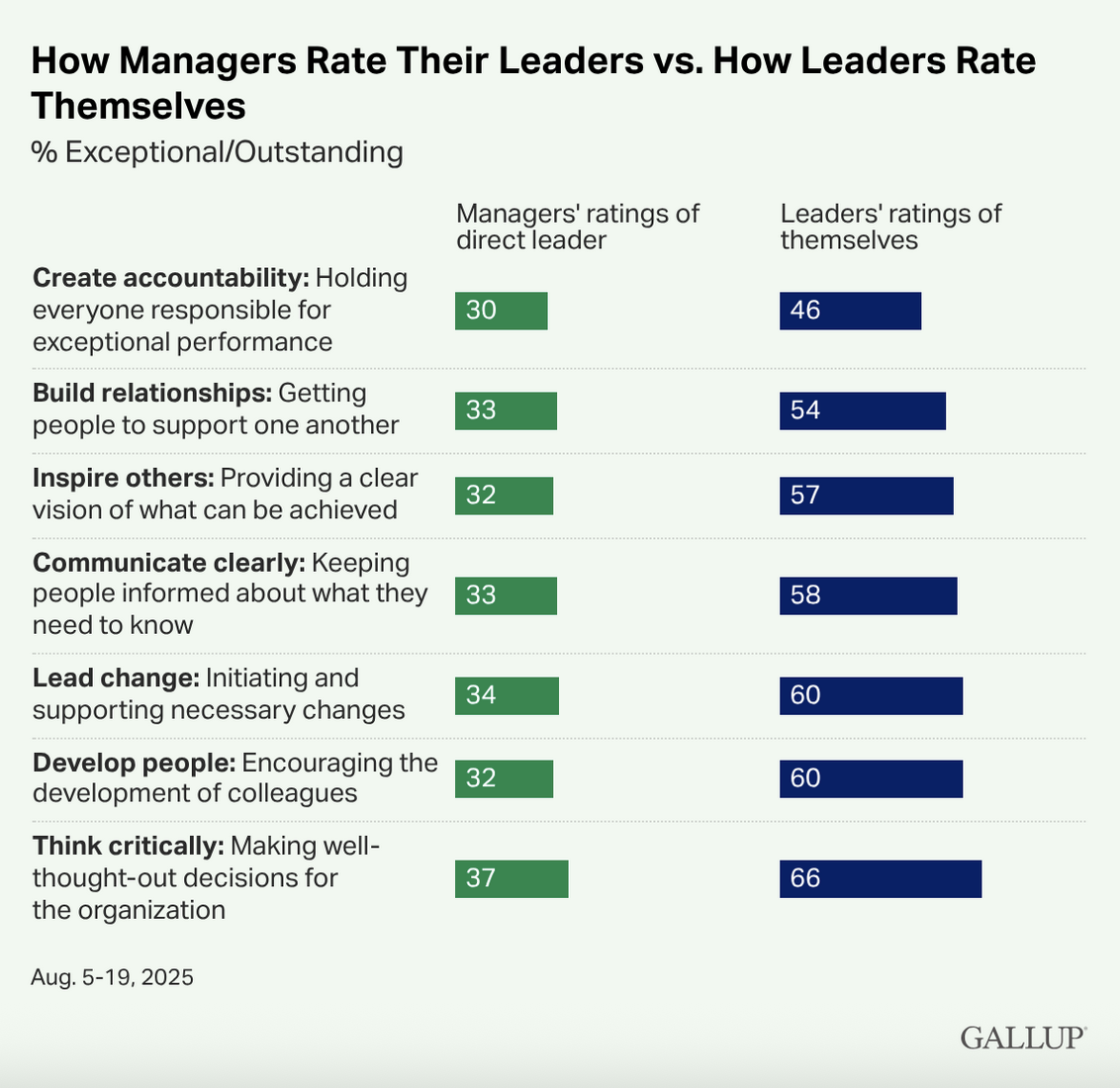
According to Gallup, in every single domain, less than 40% of managers rated their own leaders as highly competent, with the weakest domain (30%) being accountability. In fact, less than half of leaders rated themselves as highly accountable.
Why does this matter? “The 30% of managers who say their leaders are exceptional or outstanding in holding everyone responsible for exceptional performance are three times as likely to be engaged in their work as those who say their leaders are not (51% vs. 17%).”
And… employee engagement is one of the most critical variables related to organizational performance and success—when leaders fail here, they fail big.
One very concerning theme across the entire analysis is that leaders consistently overrate their own abilities compared to how the managers who report to them rate their abilities.
Where are Leaders the Strongest?
From a relative perspective, managers rate their leaders highest on the competency of critical thinking and leaders also rate themselves highest on that domain as well. However, only 37% of managers believe that is a high-level aptitude in their leaders, while 66% of leaders rate themselves highly, i.e., they rate themselves twice as highly as their managers do!
Why might accountability be the weakest leadership link?
It is not surprising that accountability among leaders is the lowest rated of the seven key competencies by both leaders and the managers who report to them. Why? Because accountability requires clear, sometimes difficult communication and conversations, which require high quality relationships and people skills. Only one third of managers report that their leaders have high competence as communicators and people leaders, so the deficit in this key area is pretty clear.
Moreover, the delta between how leaders see themselves and how their managers see them in all areas is very problematic because leaders will engage their managers based on how they think they themselves are doing and what they’re good at, not based on what managers actually need from them!
How Leaders Can Improve Accountability (and other competencies)
Improving accountability is primarily about:
increasing clarity of expectations
improving communication
strengthening relationships
Regardless of a person’s role, knowing what they are expected to do and why it matters is essential to being accountable. Because some conversations are difficult, it is vital that relationships be strong enough to support direct communication that may be uncomfortable, both for setting expectations and evaluating whether or not they’ve been met. Avoidance is the enemy of clarity, and thus of accountability.
The Transformation Collaborative™ Leadership Discovery Program
At the TC, it became clear to us years ago that due to radical, destabilizing changes in operating environments, traditional notions of leadership are not only no longer viable, they often exacerbate organizational problems, particularly related to critical factors such as engagement, purpose, and resilience. The TC Leadership Discovery program was developed with a specific focus on high impact leadership traits and behaviors for the world we operate in now as well as on supporting personal discovery, i.e., not just what we can do, but who we are. Learn how to maximize your leadership potential here!